Afghani Depreciation Fuels Soaring Prices of Essential Goods
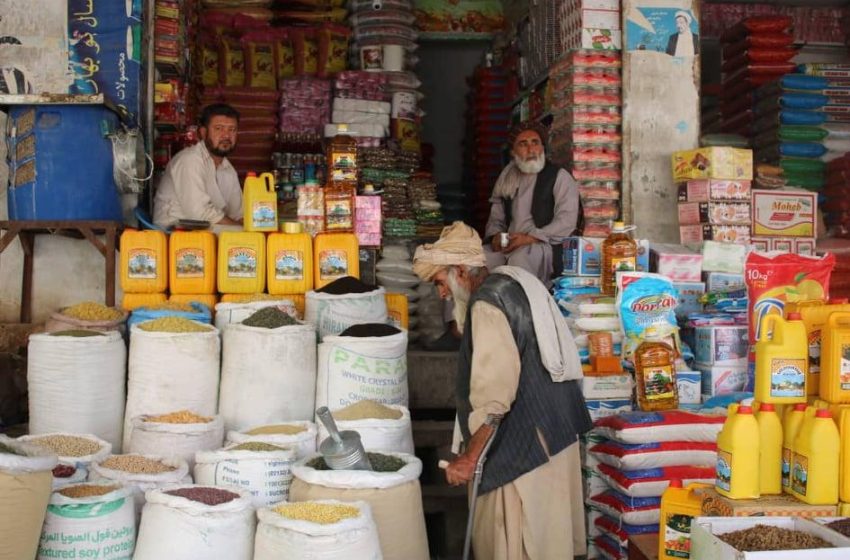
The depreciation of the Afghani has severely impacted Afghan markets, driving up the prices of basic commodities and petroleum products. Shopkeepers in Kabul report significant price hikes in essential goods, sparking concerns among the already struggling population.
Ehsanullah Darwesh, a shopkeeper at the Chaqrak food market in Kabul, told Tawazon: “When the dollar rises, the prices of food, petroleum, and other basic goods also increase. For instance, the price of a 50-kilogram bag of Kazakhstani flour has risen from 1,400 Afghanis last week to 1,800 Afghanis. Similarly, a 24-kilogram bag of Pakistani rice, previously priced at 1,950 Afghanis, is now selling for up to 2,500 Afghanis.”
Residents of Kabul express mounting frustration, citing stagnant incomes and rising costs of living. Ahmadullah, a daily wage laborer, said: “I wait all day at square, and if I find work, I earn two or three hundred Afghanis. Many days, I return home empty-handed. With these rising prices, I don’t know how to provide for my family.”
Shopkeepers attribute the price surge to the depreciation of the Afghani against the US dollar, emphasizing that Afghanistan heavily relies on imports. “All goods such as flour, rice, and oil are imported in dollars. As the value of the dollar increases, so do the prices of these goods,” said Haji Sayed Jan, a food shopkeeper in Kabul’s Mirwais Maidan.
Annual data from the Taliban’s Ministry of Industry and Commerce reveals that Afghanistan’s trade with foreign countries amounted to over $12 billion in 2024. Ministry spokesperson Akhundzada Abdul Salam Jawad stated, “Afghanistan’s total trade in 2024 was $12.422 billion, including $1.8 billion in exports and $10.619 billion in imports.”
Economic experts highlight the link between Afghanistan’s trade imbalance and the weakening Afghani. Abdul Jabbar Safi, an economic analyst, said: “Until Afghanistan reduces its reliance on imports and increases exports, the Afghani will remain undervalued, and commodity prices will continue to rise. The outflow of dollars through imports weakens the local currency further.”
The situation is compounded by the potential suspension of foreign aid to Afghanistan. Humanitarian organizations have urged the US government to exempt Afghanistan from aid cuts amid concerns over the ongoing Gaza crisis. According to Reuters, the US State Department’s Office of Foreign Assistance has exempted only Egypt and Israel from the suspension.
US President Trump has previously claimed that aid funds were reaching the Taliban, leading to his decision to halt assistance. The Taliban has denied this claim.
Experts warn that a suspension of aid could lead to catastrophic consequences for Afghanistan, where 23 million people already require humanitarian assistance. A halt in foreign aid, particularly from the US, could exacerbate the humanitarian crisis, leaving millions at risk of starvation and poverty.