Afghan Women Raise Their Voices Against Taliban Oppression at People’s Tribunal in Madrid
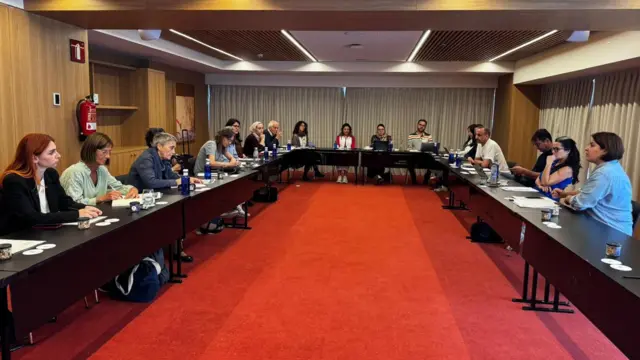
Tawazon – On the second day of the People’s Tribunal for Afghan Women in Madrid, the capital of Spain, a number of judges, prosecutors, and witnesses spoke about widespread violations of women’s rights under Taliban rule. Testimonies focused on severe restrictions on education, employment, healthcare, and basic freedoms for women across Afghanistan.
Orzala Nemat, one of the tribunal judges, stated that Taliban policies have drastically reduced women’s access to healthcare services. She explained that the number of female health workers has dramatically declined, especially in rural areas, leaving women without essential medical care in many provinces. Nemat described these policies as “discriminatory and inhumane,” warning that they are intensifying Afghanistan’s humanitarian crisis.
During the session, a para-athlete named Sahar from Khost province testified that all sports and educational opportunities for women disappeared after the Taliban took over. “I trained for years to become a champion and won many medals, but with the Taliban everything collapsed,” she said. “They even objected to my clothing, saying it was too short, but I am in a wheelchair, wearing long clothes is not possible for me.” She added that women are nwo deprived of any sports, and even traveling to see a doctor has become extremely difficult. “Taxi drivers refuse to take us because we are not allowed to travel without a male guardian,” she said.
Prosecutor Banafsha Yaqoubi told the tribunal that the Taliban have completely eliminated the rights of persons with disabilities since their return to power, calling it “a crime against humanity.” She said Afghanistan’s social support systems have collapsed nd no mechanisms remain to protect people with disabilities. Quoting a mother from Khost, she said: “A hospital refused to admit her disabled daughter because no one was allowed to touch her. This means denying a human being the right to medical treatment.” Yaqoubi stressed that Taliban policies represent “a multilayered pattern of social repression and exclusion,” not cultural or traditional practices.
Another witness, a woman protester, testified about the Taliban’s violent crackdown on women’s demonstrations. “During one protest, Taliban forces attacked me with an electric baton and injured my arm.When I went to a clinic, doctors refused to treat me out of fear of the Taliban,” she said.
She added that by banning women from studying medicine, the Taliban have destroyed future opportunities for thousands of female students. “Life for women in Afghanistan is full to fear and deprivation,” she said. “Our right to education, work, and freedom has been taken from us, but justice is our right.”
The testimony of a woman named Raha Arezo was also read at the session. She said she was attacked by the Taliban for traveling withouta male guardian. “They beat the driver and called me a ‘woman without a guardian.’ My dignity was trampled that day, but I still believe change will rise from this pain,” she said.
Human rights activist Hoda Khamosh recalled the horrific scenes of the Kabul airport explosion in August 2021. “Women, men, and children were trying to escape the Taliban. After the explosion, the scene was horrifying. I saw a child holding the body of his dead mother,” she said. Khamosh added that she later received threatening messages from the Taliban. “They told me to surrender myself to the Ministry of Intelligence. They insulted me, calling me a prostitute, and called my husband dishonorable,” she said.
Another witness, Ms. Ghyasi, testified that the Taliban have turned Afghanistan into an “open-air prison” for women. “Since the Taliban returned, fear, humiliation, and deprivation have become part of daily life for Afghan women,” she said.
The Madrid session is part of the People’s Tribunal on Taliban Atrocities, established to document and pursue accountability for human rights violations, particularly against Afghan women and girls.