Hands Searching for Hope in the Narrow Streets of Kabul
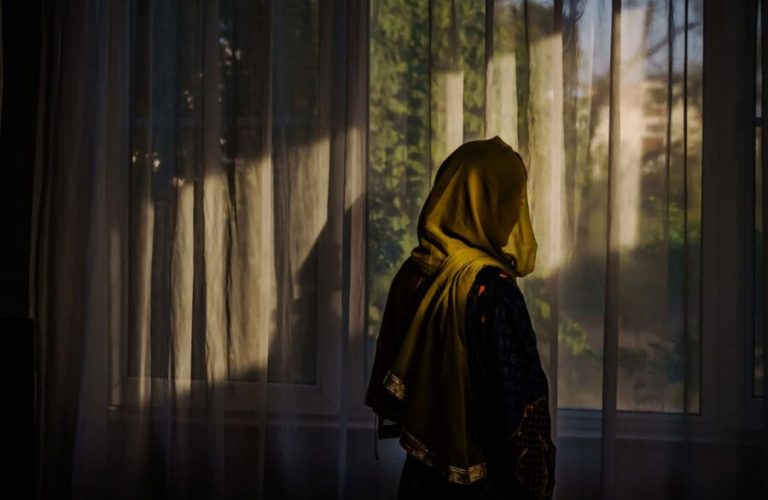
Tawazon – In the narrow and crowded alleys of Kabul’s Mandawi bazaar, where poverty and perseverance intertwine, countless women struggle every day for a meager piece of bread. Among the dust-covered faces and calloused hands, the story of Marzia reflects the shared pain of hundreds of women who continue to live under layers of social injustice and growing restrictions.
This report offers a brief but deeply sorrowful journey into the world of women who carry untold stories of suffering and resilience while balancing between survival and hope.
After several phone calls, I finally managed to find the workplace of Marzia. The crowded and twisting lanes of Mandawi forced me to walk the entire way. The narrow passages, the endless crowd, the burning heat, and the uncertainty of the address all made my steps heavier. Young men, teenagers, and even elderly men moved through the streets pushing carts or carrying sacks on their shoulders, each struggling to earn a little for their families.
Yet, I kept thinking about Marzia: what hardships had she endured just to earn this daily bread and what new ones still awaited her?
When I finally reached the building, the steep and narrow staircase almost stole the strength from my legs. I had to push myself to climb to the third floor and finish the interview within the next hour. On third floor, I saw several women cleaning almonds, their cracked lips, pale cheeks, and dusty faces etched with silent despair. Each of them seemed to hold a story worth listening to. When they saw me, some hastily adjusted their head scarves, others just stared in silence. The air was heavy until the supervisor broke the stillness with a brief greeting.
The supervisor, a woman in her fifties named Nasreen, had worked there for seven years. She welcomed me warmly, placed a wooden chair for me, and even laid a sack over itso my clothes wouldn’t get dirty. Moments later, she brought green tea with almonds and pistachios and I thanked her.
While the workers continued sorting almonds, I noticed Marzia sitting quietly in the corner. With permission from the supervisor, I approached her. She stood like a withered willow, her eyes filled with worry and fear – perhaps of the interview, of her painful memories, or of the life she was forced to endure. I tried to ease her tension with a few simple questions, hoping to bridge the distance between us.
When I asked about her life and why she had to do such hard labor for such little pay, she looked at me with tired eyes and trembling hands. Pressing her palms together, maybe to hide the shaking, she began to speak.
Marzia’s husband is addicted to drugs. For her children, she has become both father and mother. She has been cleaning almonds here for four years, earning only 300 Afghanis a day. Her pale, yellowish face revealed her illness. When I asked about her health, she replied in a faint voice: “I’m very sick. I feel feverish. I can’t afford to see a doctor. Working here gets harder every day, but I have no choice. We’re paid daily wages, if I miss one day, I lose that day’s pay.”
With tears in her eyes as she continued: “Before the fall of the Republic, my husband worked at a factory. When the Taliban came, the factory shut down.He lost his job and became addicted. Now, when he needs money for drug, he beats me and the children if I tell him we have nothing. Sometimes I can’t even walk from the pain, but I still come to work. I have no other way.”
Her quiet sobs filled the room. I wanted to hold her and let her cry freely, but I stayed composed, not wanting my own tears to weaken her strength. She went on: “I earn 300 Afghanis a day, but it’s not enough; rent, food, everything is expensive. And I also have to give my husband money for drugs.”
She then pointed to a thin girl beside her, about 14 years old, saying: “This is my daughter, Ramzia (name changed). She studied until Grade 6, but after the Taliban came, she had to stop school. Now she works here with me. I can’t manage the household expenses alone.”
I looked at Ramzia, her large dark eyes filled with a painful innocence. The burdens of life had already stolen the glow of her youth. Her mother explained before I could even ask: “She hs breathing and kidney problems. The doctor told me to keep her away from dust, but she must help me, life is hard, and we are forced to work.” Thousands of questions ran through my mind: why must a woman bear so much suffering? why must a young girl’s spring of life turn into autumn so soon?
Marzia broke the silence: “I’m sorry, I need to get back to work.”
I thanked her and left, carrying countless unanswered questions in my mind. But Marzia is not alone. Hundreds of women work in similar conditions, each with their own story of pain and endurance, each fighting daily just to feed their families.
Women’s rights activist Suraya Paikan says that the absence of legal protections for women in Afghanistan has severe consequences for children and society: “A mother with no income or support often sends her children to work on the streets to cover rent or daily food. These children are deprived of education and have no promising future. Every society needs laws that protect its people, but Afghanistan has no specific law to protect women, and even if such laws exist, they are not implemented.”
Economic experts emphasize the need for investment in Afghanistan’s economic infrastructure to empower female breadwinners. They argue that the current Taliban administration must cooperate with private and international organizations to create a sustainable economic system. Economist Iraj Faqiri explain that recent restrictions on women’s employment have deepened poverty and reduced household purchasing power: “We can only support women-headed households when we build Afghanistan’s economic foundations. That means creating job opportunities inside the country through both domestic and foreign investment.”
Since the Taliban’s return to power, leader Hibatullah Akhundzada has issued more than 65 decrees regarding women. These include severe restrictions on education, employment, social participation, and even personal freedoms. Women are banned from secondary schools, universities, and most government and NGO jobs. Many have had their salaries cut or been dismissed entirely.
The Taliban have also banned women from parks, gyms, and even dictated how windows in homes should be built so women cannot be seen from outside. In December 2021, they issued a decree on women’s rights in marriage and inheritance, claiming that women should not be forced into marriage and have the right to inherit property. However, the decree made no mention of the right to education or work. These policies have sparked widespread international condemnation with global organizations calling them a violation of human rights and a potential crime against humanity.