The Taliban’s Motives Behind the Internet Shutdown in Afghanistan

Tawazon publishes independent analyses, articles, and opinion columns. The views expressed are solely those of the authors and do not necessarily reflect the position of Tawazon.
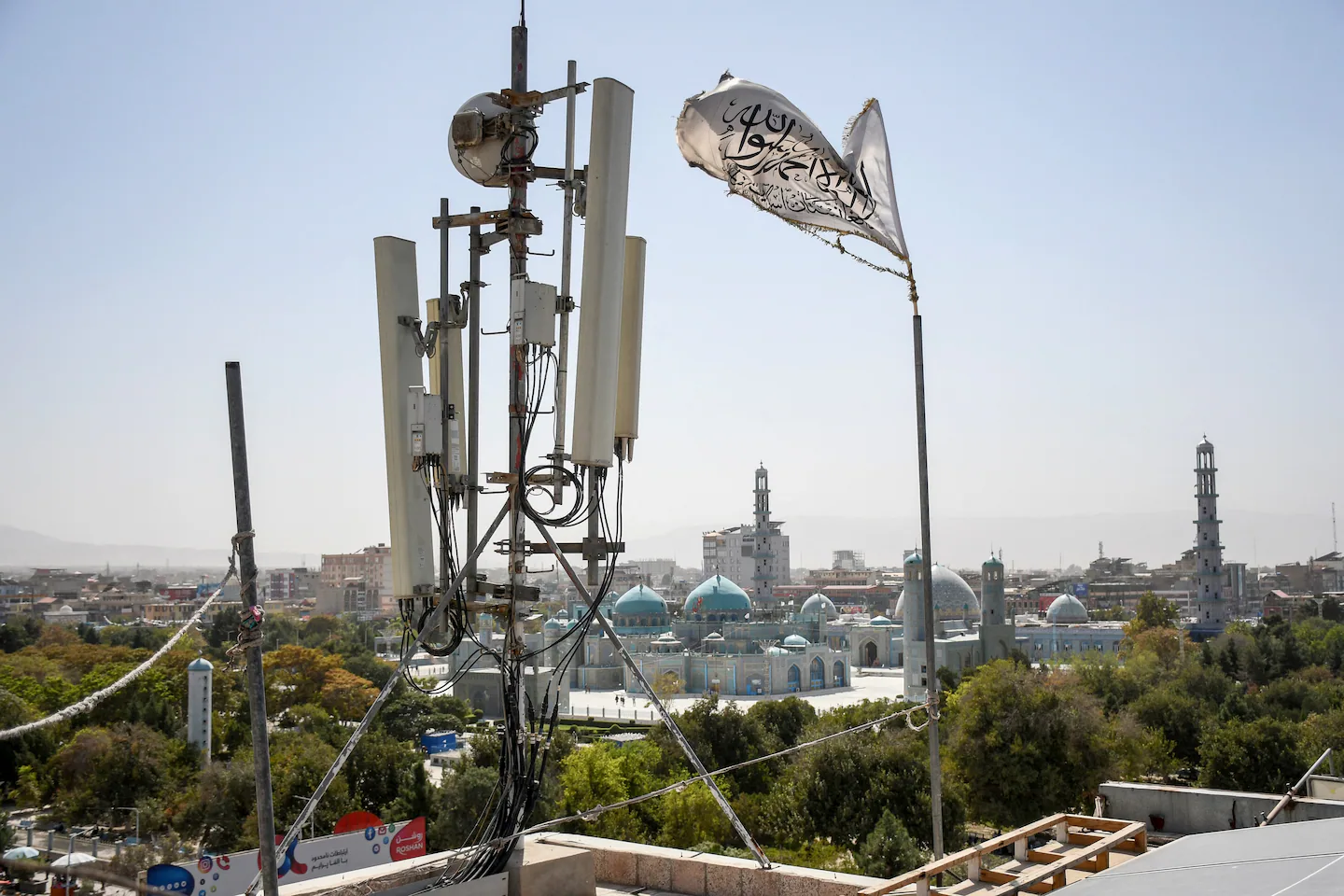
Tawazon – In recent months, the Taliban implemented a gradual and then complete shutdown of fiber-optic internet across Afghanistan. Initially, the group claimed the suspension was temporary and part of a broader plan to improve infrastructure. Shortly thereafter, partial service was restored in a province-by-province manner. However, on September 30th, the Taliban enacted a full nationwide internet blackout. This moves not only deprived girls and women of access to online education but also disrupted nearly every sector of Afghan society. The central question therefore arises: why did the Taliban undertake such a drastic measure?
Multiple explanations have been advanced, yet the political motivations of the Taliban appear to be the most significant. These motives may be analyzed under five interrelated dimensions:
1. The Secret Deal Concerning Bagram Air Base
Bagram Air Base, located in Parwan province near Kabul, has historically attracted the interest of global powers due to its strategic significance. Constructed in the 1950s and expanded during the Soviet presence (1979–1989), it has remained central to U.S. military strategy in the region. U.S. President Donald Trump repeatedly emphasized his intention to regain control of Bagram during his election campaigns and reportedly initiated discussions with the Taliban on this matter.
While the Taliban’s interim administration initially expressed resistance to foreign interference, internal divisions soon emerged. Some Taliban officials publicly rejected the idea of handing over the base, even threatening to reactivate suicide squads in its defense. In response, Trump warned of severe consequences if the Taliban failed to comply. Confidential reports suggested that Taliban leaders convened in Kandahar to deliberate on the issue.
Meanwhile, China, along with Russia, Iran, and Pakistan, opposed the prospect of renewed U.S. control over Bagram, framing it as a violation of Afghan sovereignty. Despite this, the Doha Agreement—under which the Taliban rose to power—grants the United States conditional rights to use Afghan soil in counterterrorism operations. According to former U.S. official Sarah Adams, the Taliban’s internet blackout was intended to conceal the relocation of militants from Bagram and to facilitate a covert transfer of the base to the United States. Public disclosure of such a deal would undermine the Taliban’s twenty-year narrative of waging jihad against foreign “infidels,” thereby threatening their ideological legitimacy. To suppress public debate and social media exposure, the Taliban opted to block internet access.
2. Concealing Internal Factional Divisions
The Taliban are deeply fractured along factional lines, primarily among the Kandahar faction (led by Hibatullah Akhundzada), the Haqqani Network (with significant regional and international ties), and the relatively moderate Doha faction. The rivalry between the Kandahar leadership and the Haqqani group has become especially acute. Sirajuddin Haqqani, the Taliban’s Interior Minister, has undertaken foreign trips to bolster his position, allegedly with the backing of Arab states and the United States. He has publicly criticized Hibatullah for monopolizing power.
Tensions escalated further when Hibatullah reportedly dismissed Haqqani from his ministerial post. In response, Kandahar forces attempted to detain him in Khost province, fearing a potential coup orchestrated by the Haqqani. To prevent these internal disputes from spreading through Taliban ranks or reaching the public, the leadership restricted flights, blocked telecommunications, and enforced the internet shutdown.
3. Concealing Corruption and Abuses
Although the Taliban officially claimed that the blackout was designed to curb the spread of pornography and immorality, the reality suggests otherwise. In the digital age, social media operates as a mechanism of accountability, documenting human rights abuses, corruption, and misconduct. Prior to the shutdown, online platforms frequently exposed Taliban practices such as child recruitment, extrajudicial killings, and systemic corruption. To suppress this flow of information and protect their image, the Taliban eliminated digital access nationwide.
4. Intensifying the Ban on Women’s Rights
Since seizing power, the Taliban have systematically restricted women’s rights: closing girls’ schools beyond grade six (March 2022), banning women from universities (December 20, 2022), and prohibiting female employment in NGOs (December 24, 2022). Despite these restrictions, many women and girls continued their education through online platforms and engaged in remote employment. The internet blackout extinguished these limited opportunities, reinforcing the Taliban’s broader strategy to erase women from public life and silence their activism, including protests and demonstrations.
5. Media Censorship and the Information War
From the outset, the Taliban imposed strict controls on domestic media, including censorship, arrests of journalists, and restrictions on permissible language. Despite these efforts, exiled Afghan media outlets continued to disseminate accurate information internationally, aided by local journalists operating clandestinely inside the country. The Taliban perceived this as a threat to their narrative of stability and normalcy. Consequently, shutting down the internet served as a tool of information warfare, aimed at controlling narratives, silencing dissent, and concealing the country’s deteriorating conditions from global scrutiny.
In conclude, The Taliban’s decision to enforce a nationwide internet shutdown cannot be explained merely as a technical or moral measure. Rather, it represents a calculated political strategy with multiple objectives: concealing negotiations over Bagram Air Base, masking internal factional rifts, suppressing exposure of corruption and human rights violations, eradicating women’s limited avenues for education and activism, and controlling both domestic and international narratives. In essence, the blackout was part of a broader information war designed to consolidate Taliban power, protect its legitimacy, and insulate its rule from domestic dissent and international criticism.